
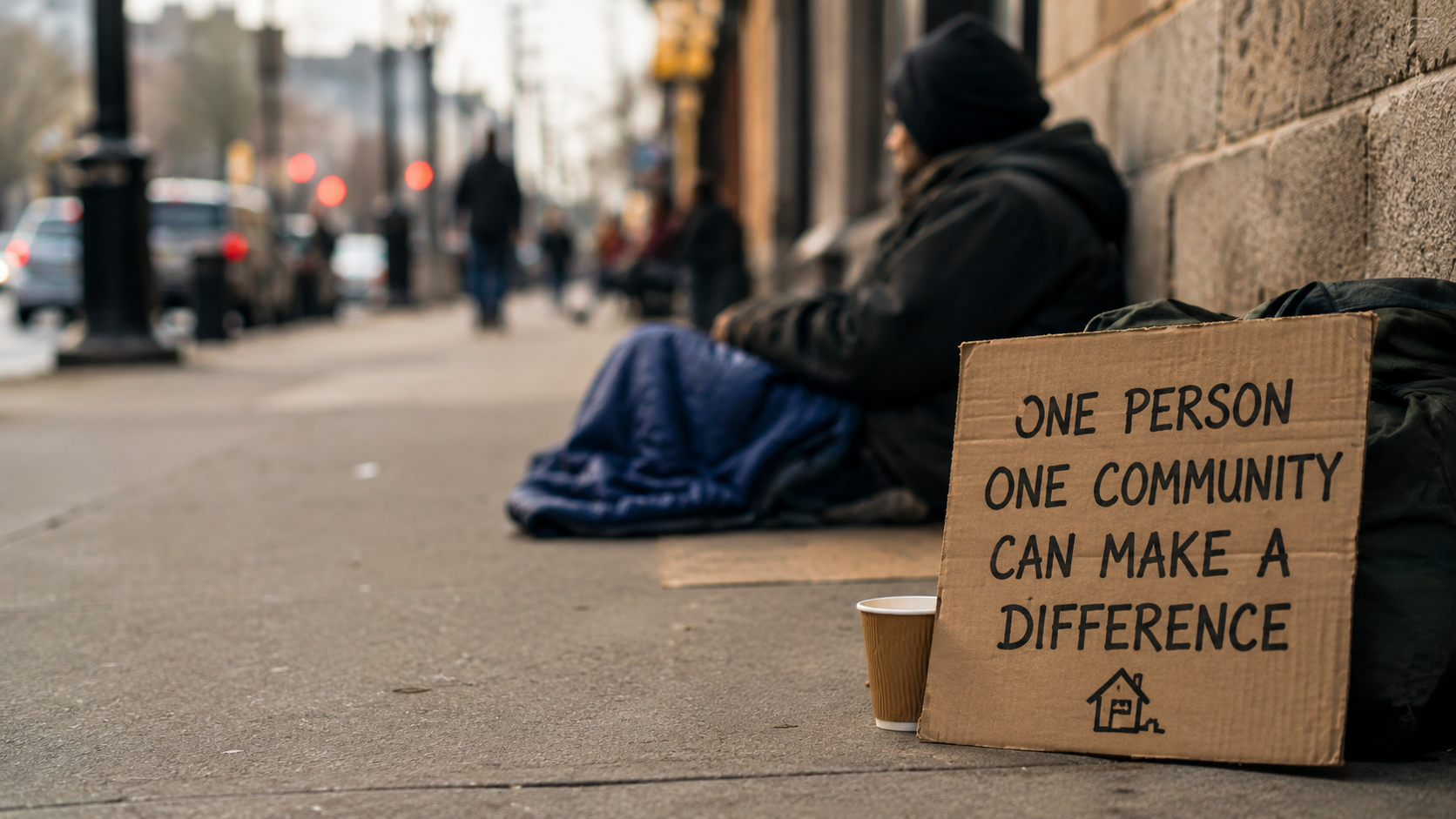
It’s been far too long since I posted. Wanted to reframe my original concept to help those experiencing homelessness. On any given night, more than half a million people in the United States experience homelessness. It’s a number so large that it’s difficult to comprehend. Imagine every resident of an entire state like Wyoming suddenly without a place to call home.
When we hear statistics like these, it’s easy to feel powerless.
We wonder, How could one person possibly make a difference?
Maybe that’s the wrong question.
- What if the better question is, “Who can I help?”
Big Problems Are Solved One Person at a Time
Homelessness is an incredibly complex issue. There isn’t a single cause, and there won’t be a single solution. Mental health, addiction, job loss, domestic violence, medical debt, rising housing costs, family breakdowns, and countless other circumstances all contribute to people finding themselves without a home.
Because the problem is so large, we often think only governments or major nonprofits can solve it.
But history tells us something different.
Nearly every meaningful movement begins with people deciding to help one person, one family, one neighborhood at a time.
Instead of asking, “How do we end homelessness?”
What if we asked:
What does Bob need to get back on his feet?
Or…
What would it take for Mary to have a safe place to sleep, a job, and hope again?
Those are questions we can answer.
A Different Way to Think
I believe we’ve spent too much time thinking about homelessness at the macro level.
We talk about numbers.
Budgets.
Policies.
Programs.
Those conversations are important, but they often overlook the individual human being behind the statistic.
Every homeless person has a story.
Every person has different obstacles.
Every person has different strengths.
Instead of trying to solve homelessness all at once, what if communities rallied around specific individuals?
Imagine volunteers, businesses, churches, nonprofits, employers, landlords, healthcare providers, and everyday citizens coming together to help one person at a time.
One person may need an apartment deposit.
Another may need a driver’s license.
Someone else may need work boots, transportation, medication, childcare, or simply someone willing to mentor them through the process.
The needs are different.
The goal is the same:
Help this one person become permanently housed and self-sufficient.
Then do it again.
And again.
And again.
Crowdsourcing Compassion
One person rarely has every answer.
Thousands of people, however, possess an incredible amount of collective knowledge.
That’s why I believe crowdsourcing can become one of the most powerful tools in addressing homelessness.
Some people know housing.
Others know employment.
Some understand addiction recovery.
Others specialize in mental health, legal assistance, education, financial coaching, or workforce development.
When we connect these experiences together, something remarkable happens.
Ideas improve.
Resources multiply.
Barriers disappear.
The brightest solutions often come from people working together rather than working alone.
Not Replacing Existing Organizations
This isn’t about replacing homeless shelters, nonprofits, social workers, or case managers.
Quite the opposite.
Most of these organizations are already doing extraordinary work with limited resources.
Many are understaffed and overwhelmed.
So many simply don’t have enough time to provide everything every client needs.
The community can become an extension of their work.
Imagine a case manager saying,
“Bob needs a bicycle so he can get to work.”
Within hours, someone donates one.
“Mary needs professional clothing for interviews.”
A local business steps in.
“James finally has housing but needs furniture.”
Neighbors furnish the apartment.
Small acts become life-changing moments.
Make Giving Personal
Millions of people generously donate money every year.
Those gifts matter, but something changes when generosity becomes personal.
When you know the person you’re helping…
When you celebrate their first job…
When you see them move into their first apartment…
When you watch their children return to school…
Giving becomes a relationship rather than a transaction.
- People don’t simply donate to a cause. They become invested in another person’s success.
That’s powerful.
Learn From What Already Works
No one organization has all the answers.
Fortunately, incredible programs already exist throughout the world.
Some focus on housing.
Others emphasize employment.
Some specialize in mental health.
Others create pathways for veterans, families, or youth.
Rather than reinventing the wheel, we should identify what works, learn from it, share it, and replicate it.
We should celebrate those successes.
Then ask one simple question:
How can we build on them?
Imagine the Ripple Effect
- Suppose one community helps one person every month.
Now imagine one hundred communities doing the same thing.
Then one thousand.
Eventually, helping individuals creates momentum.
Momentum becomes movement. Movement becomes transformation.
No, homelessness will never disappear overnight.
People will continue to face hardship.
Life will continue to surprise us.
But becoming homeless doesn’t have to mean staying homeless.
That is a goal worth pursuing.
The Invitation
I don’t pretend to have all the answers.
In fact, I believe the answers already exist—they’re simply scattered among millions of compassionate people who have never been connected.
That’s why this movement starts with listening.
Learning.
Sharing.
Collaborating.
And most importantly…
Helping one person at a time.
Because every statistic has a name.
Every name has a story. That’s why I wrote about Cindy.
Every story deserves another chapter.
Maybe the end of homelessness doesn’t begin with changing the world.
Maybe it begins by changing one life.
Then doing it again tomorrow.